That Sketch Lives in Your Head Rent-Free — Here's Why
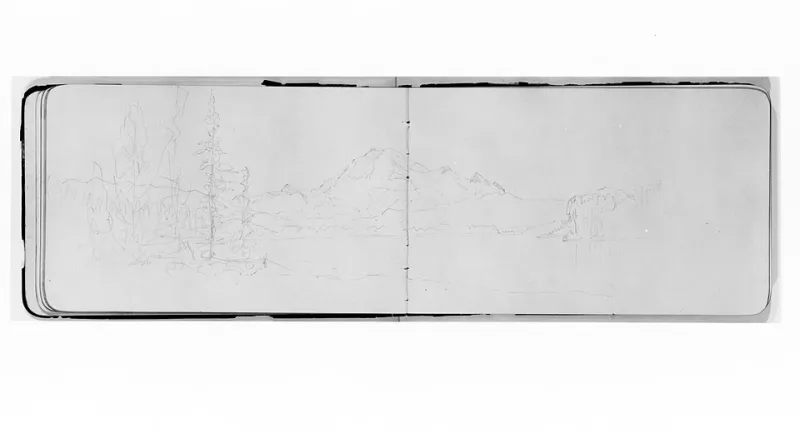
Photo: Albert Bierstadt, CC0, via Wikimedia Commons
You drew it months ago. Maybe years. It was rough — probably just a few loose lines on a sticky note or a chaotic page buried somewhere in the middle of a sketchbook you've since filled and abandoned. But it never really left. That sketch, that idea, keeps floating back up to the surface like it's trying to tell you something.
Every artist has at least one of these. A doodle that got under your skin. A thumbnail that felt electric for reasons you couldn't fully articulate. And the question most of us never stop to ask is: why that one? Why does that sketch haunt you while a hundred other drawings you spent way more time on have completely faded from memory?
The answer matters more than you might think — because the difference between a sketch that's genuinely brilliant and one that's just perpetually unfinished can cost you hundreds of hours if you get it wrong.
The Brain Is a Pretty Selective Archivist
Here's something interesting from the world of cognitive psychology that applies directly to creative work: the Zeigarnik Effect. Bluma Zeigarnik, a Soviet psychologist, discovered in the 1920s that people remember incomplete tasks far more vividly than completed ones. Your brain essentially puts a sticky flag on anything unresolved and keeps checking back on it.
For artists, this plays out constantly. A sketch you finished, refined, posted, and got feedback on? Your brain filed that away. Done. But the sketch you never quite executed the way you envisioned it? That one stays open. Your subconscious keeps the tab running.
This is actually useful information. When a sketch won't leave you alone, part of what you're feeling is the cognitive discomfort of an unresolved loop. Your brain wants to close it. The question is whether the idea deserves to be closed — or whether it should stay open a little longer.
Brilliant vs. Just Unfinished: The Hardest Question in Art
This is where things get genuinely tricky, and honestly? Most artists don't think about it carefully enough before diving back in.
Some sketches haunt you because they contain a real idea — a composition, an emotional dynamic, a character expression — that you haven't fully realized yet. The rough version caught something true, and your instincts recognize that even if your conscious brain can't name it. That's the sketch worth chasing.
But other sketches haunt you for a completely different reason: they represent a version of yourself you wanted to be when you drew them. The concept felt ambitious. You were excited. And the fact that you never finished it has become tangled up with feelings about your own growth, your own procrastination, your own creative identity. That sketch isn't unfinished because it's brilliant. It's unfinished because finishing it felt scary.
Distinguishing between those two is genuinely hard. Here's one approach that actually helps: try to describe what the sketch is about out loud, to yourself or to a friend. Not what it depicts — what it's about. If you can articulate something specific and emotionally resonant, that's a good sign the idea has real substance. If you find yourself describing mostly vibes and potential without anything concrete, you might be chasing a ghost.
What Makes a Sketch Genuinely Stick
Beyond the unfinished-task effect, certain sketches earn their permanent real estate in your mental landscape through a few specific qualities.
Tension. The most haunting sketches usually contain some kind of unresolved visual or emotional tension. Two characters mid-conversation. A figure in an ambiguous pose. A composition that suggests movement or conflict without resolving it. Tension invites the viewer — even when the viewer is just you — to complete the story. Your brain keeps returning because it wants to finish the sentence.
Accidental discovery. A lot of artists report that their most persistent sketches came from moments when they weren't trying very hard. You were doodling absent-mindedly, or warming up, or just killing time — and something appeared on the page that surprised you. That surprise is important. It means the idea came from somewhere deeper than your deliberate creative choices, and your instincts recognize that it might be worth excavating.
Personal resonance. The sketches that stick are almost always connected to something you actually care about — a character relationship you find genuinely fascinating, a theme that recurs in your life, an aesthetic that reflects something true about how you see the world. Generic ideas don't haunt people. Personal ones do.
The 48-Hour Test and the Six-Month Test
Before you commit serious time to developing a haunting sketch into a full piece, it's worth running two simple tests.
The 48-hour test: Sit down and try to develop the sketch right now. Spend an hour with it. If the idea expands — if new possibilities open up as you work — that's a strong signal. If you immediately hit a wall and can't figure out what the sketch actually is beyond the original doodle, that's worth noting.
The six-month test: If you've been circling a sketch for six months or more without touching it, ask yourself honestly whether you've been protecting it. Sometimes we keep an idea in the "someday" category because working on it and potentially failing would hurt more than just leaving it perfect and untouched in our imagination. That's a fear response, not a creative one.
The sketches worth returning to are the ones that make you want to work despite the fear of getting it wrong.
Living With the Ones You Don't Chase
Not every haunting sketch needs to become a finished piece. Some ideas are meant to stay in the sketchbook, doing their quiet work of informing your aesthetic sensibility, showing up in the DNA of other pieces, reminding you of who you were when you drew them.
There's no rule that says every good idea has to be fully realized. Some of the most honest things in an artist's practice are the rough drawings that never got cleaned up — the ones that captured something true precisely because they were made quickly, without overthinking.
If a sketch has been living in your head for years and you still haven't touched it, maybe the question isn't when will I finish this? Maybe it's what has this sketch already given me?
That's a pretty different conversation — and honestly, a more interesting one.
The Takeaway
Your brain is not randomly haunted. When a sketch refuses to leave, it's usually because something in it resonates — with your instincts, your fears, your genuine creative obsessions. Learning to read that signal, to separate the ideas that deserve your full attention from the ones that are just emotionally loaded, is one of the more underrated skills in any artist's toolkit.
Pay attention to what sticks. It's probably trying to tell you something.