Why You Keep Drawing That Same Scene Over and Over — And Why It's Making You Better
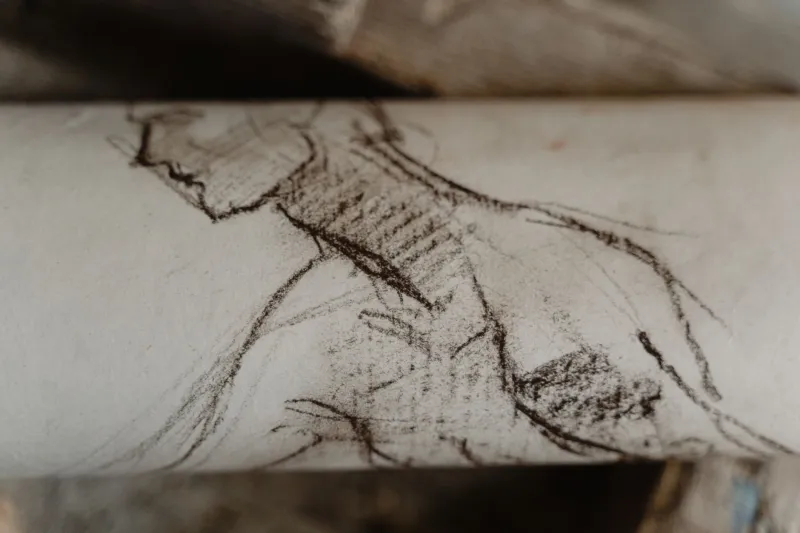
There's a specific kind of creative spiral that most artists know intimately but rarely talk about out loud. It starts innocently enough — you watch a show, read a manga, play through a game, and then that moment hits you. You know the one. The emotional gut-punch. The quiet scene that somehow destroys you more than the loud ones. And before you know it, you've filled three sketchbook pages with your version of it. Then five. Then you're on your twelfth iteration and your friends are gently asking if you're okay.
You are okay. You're actually doing something kind of genius.
What's Really Happening When You Can't Let a Scene Go
Hyperfixation gets a bad rap. In creative circles especially, there's this unspoken pressure to keep moving — new characters, new styles, new fandoms, new everything. Staying locked onto one thing can feel embarrassing, like you're stuck or creatively limited. But the psychology behind artistic obsession tells a completely different story.
When you return to the same scene repeatedly, you're not just redrawing it. You're interrogating it. Each pass through that moment is your brain asking a slightly different question — why does this hit so hard? What am I not capturing yet? What does this character's face actually look like when they feel this? You're essentially running the same emotional experiment over and over until you get an answer that satisfies something deep in your creative gut.
Cognitive psychologists call this kind of focused repetition "deliberate practice," and it's widely recognized as one of the most effective pathways to genuine skill development. The key word there is deliberate — you're not mindlessly copying. You're actively problem-solving, even when it doesn't feel that way.
The Scenes Artists Can't Quit (And What Their Iterations Reveal)
This isn't a new phenomenon. Before the internet gave us fandom archives and Twitter art threads, artists were doing this exact thing — obsessively revisiting pivotal moments until something clicked.
Take the classic example of Japanese woodblock artists who would return to the same landscape or figure dozens of times across their careers, each version slightly more refined, more emotionally precise. Hokusai's various depictions of Mount Fuji weren't just stylistic exercises — they were a decades-long conversation with a single subject.
In contemporary fan art culture, you can see the same pattern play out in real time. Scroll through any artist's archive and you'll almost always find a cluster — a handful of pieces that keep circling back to the same source material moment. The confession scene. The final battle. The quiet breakfast that somehow meant everything. The artists who let themselves go deep on those moments tend to show the most dramatic technical growth across those specific pieces, not because they practiced more hours overall, but because the emotional investment made every hour count more.
What Each Redraw Is Actually Teaching You
Here's the thing about obsession-driven art: each new attempt isn't just a visual upgrade. It's a layer of understanding being added to your internal library.
Your first version of that scene is probably about composition — getting the basic shapes down, figuring out where everyone is standing. Your third version starts wrestling with expression. By version seven, you're deep in the weeds of lighting and what the emotional temperature of the moment actually feels like in color. By version twelve, you're making choices so specific and intentional that you've essentially developed a personal visual language for that one emotional beat.
That's not a small thing. That's mastery being built in a way that no anatomy worksheet or color theory tutorial could ever replicate, because it's attached to something you genuinely care about. Passion is the variable that textbook practice leaves out.
The Fan Art Angle Nobody Talks About Enough
There's something uniquely powerful about this happening in fan art specifically. When you're drawing an original character or scene, you're building the emotional context from scratch. But when you're working from existing source material, you come in with a fully loaded emotional response already in place. You know what the scene means. You know why it matters. That pre-existing feeling becomes the engine driving your technical development forward.
Fan artists who obsessively redraw pivotal moments from their favorite media are essentially using someone else's storytelling as a training ground for their own emotional expression. You're learning how to translate feeling into visual information — which is, honestly, one of the hardest skills in any visual art form. And you're learning it in a context where the stakes feel real because you actually care.
This is why fan art communities consistently produce some of the most emotionally resonant work on the internet. The obsession isn't a quirk. It's a method.
When the Obsession Starts to Shift
One of the most interesting things that happens when you let yourself fully commit to a scene is that eventually, something changes. The fixation doesn't disappear — it evolves. You start to notice that what drew you to that moment in the source material is the same thing that shows up in your original work. The recurring emotional themes in your hyperfixation become a kind of self-portrait.
Artists who've gone deep on this often describe a moment of recognition — realizing that the scene they couldn't stop drawing wasn't just about the characters. It was about something they were working through personally. The art was doing emotional labor they hadn't consciously assigned it.
That's not a coincidence, and it's not something to feel weird about. It's actually one of the most honest things art can do.
Give Yourself Permission to Be Obsessed
If you've been low-key embarrassed about the fact that you've drawn the same two characters in the same emotional standoff fourteen times this year, consider this your official permission slip to keep going. Your brain isn't broken. Your creativity isn't limited. You're doing the deep work — the kind that looks repetitive from the outside but is anything but on the inside.
Let the scene haunt you. Draw it again. Then draw it again after that. Pay attention to what changes each time — not just technically, but emotionally. Notice what you're still trying to say that you haven't quite gotten right yet.
That gap between what you feel and what you can currently put on the page? That's the whole game. And obsession is how you close it.